


Greece bets on space technology to contain wildfires
Greece bets on space technology to contain wildfires

By DEREK GATOPOULOS Fri, June 26, 2026 at 9:15 AM UTC
1
ATHENS, Greece (AP) — In the searing Mediterranean summer, wildfires turn dangerous in minutes.
Greece has learned that at a terrible cost. In 2018, a blaze east of Athens moved with ferocious speed, killing more than 100 people. Five years later, a massive fire tore through a remote nature reserve; it was the largest wildfire ever recorded in the European Union.
Greece is looking to the heavens for help, with a dedicated satellite constellation that monitors for fires. It's a model for the continent as Europe races toward broader independence in space technology.
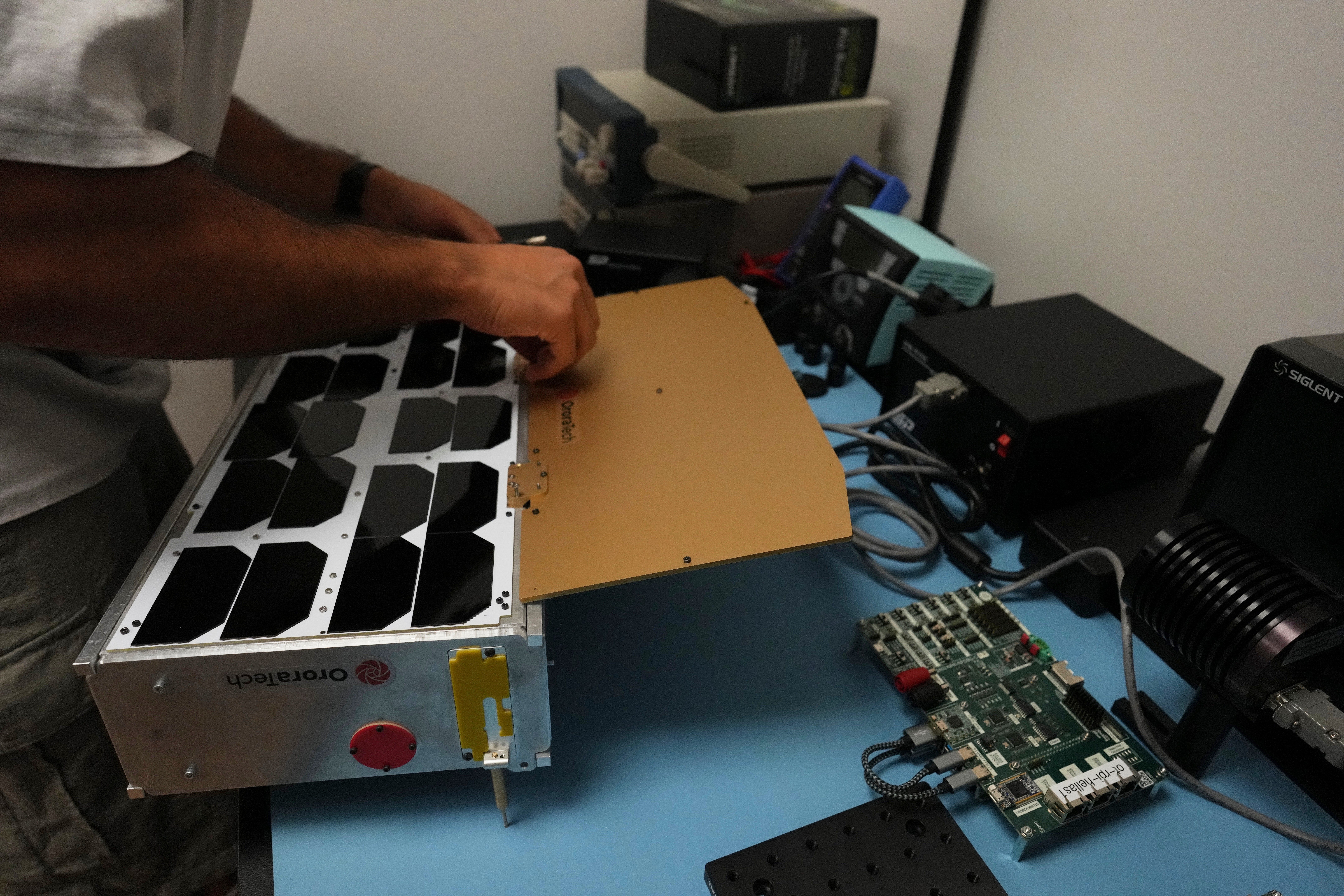
Four satellites, each smaller than a piece of carry-on luggage, were launched into low orbit in May. That made Greece the first nation in the world to integrate a dedicated satellite array into its national firefighting system.
Built by German company OroraTech, the satellites carry thermal sensors designed to flag new blazes as small as four meters (13 feet) wide, beating traditional satellites that can only spot fires the size of a cruise ship.
Satellites help manage multiple wildfires
As Europe struggles with its latest blistering heatwave, the high temperatures foreshadow the wildfire season. Fires pose a unique challenge in Greece with its tinder-dry mountainous mainland and over 100 inhabited islands.
If a fire ignites, AI-processed satellite data is sent as an alert to commanders with the location, size and intensity already calculated. If multiple fires are burning at once, real-time data is crucial to determining response.
“For example, if you have 10 fires all over Greece and the fire radiative power is lower in some cases, you will not give priority to those ignitions; you will give priority to other ones,” Fire Service Col. Zisoula Ntasiou, vice president of the International Association of Fire and Rescue Services, told The in an interview.
Thermal sensors also pick up solar panels, hot factory roofs and sunbaked rock faces, but AI models are built to filter out those false alarms before alerts reach emergency services, according to officials involved in the program.
Hotter summers require better AI models
Greece recorded its hottest summer on record in 2024 and its third-hottest last year.
“The global temperature is going up. That causes fires to change in intensity and ferocity,” Ioannis Lantouris, head of OroraTech’s Greek operations, told the AP. “Our models have to change and adjust to that. They have to be faster. They have to be more precise.”
Lantouris spoke in his office in Athens, while engineers worked on fire behavior models. Near their desks, they keep a life-sized replica of the satellite.
Thermal satellites add a layer of detection to drones and ground sensors, and Greece has expanded both since the 2018 disaster forced an overhaul of wildfire response. The constellation helps fill coverage gaps from international satellites, spot fires in remote terrain and build more detailed models of fire behavior.
Advertisement
Multiple countries use thermal satellites but Greece is the first to fully integrate them into its firefighting system. The satellites themselves mark an early stage of a broader Europe-backed effort.
Greece is building a wider observation network with three European companies, combining thermal satellites, radar satellites capable of seeing through clouds and smoke, and optical satellites that capture highly detailed imagery of the ground.
That network carries a total price tag of 200 million euros ($227 million) and is funded by the EU. Falling costs for launch and manufacturing have made the expansion possible. Additional satellite deployments are planned by the end of the year.
Future ideas include border surveillance
Planners in Athens and across Europe already envision applying the same kind of network far beyond fire detection. Future systems will support border surveillance, crop management, disaster response and heat-wave planning.
One priority is identifying urban “heat islands,” allowing authorities to target cooling centers and emergency services more effectively.
The ambitions follow a strategic shift to seek greater technological independence. Rattled by Russia’s war in Ukraine and strained trans-Atlantic ties, European governments are reducing dependence on foreign technology.
Space infrastructure has become a pillar of that effort.
“These technologies support civil protection, security and, where necessary, defense-related applications,” Dimitris Papastergiou, Greece’s minister of digital governance, said in an interview at his office in Athens.
“The knowledge generated through these investments should remain in Europe and be combined with other European capabilities, including telecommunications and AI infrastructure,” he said.
Papastergiou announced Friday that the EU is planning to further boost funding for the Greek programs with an additional 350 million euros.
Greece’s satellite network is part of a European push linking launch vehicles, navigation systems, Earth observation networks and secure communications into a more sovereign technological ecosystem.
The goal, officials say, is to move beyond satellite imagery as a passive tool and develop near-real-time decision systems that help governments manage crises as they happen.
The blazing Greek summer will offer an initial test.
Source: “AOL Breaking”
